Website expansion in progress...prototype coming soon.

Research
Methodology Note
This page describes how Emotional Pattern Intelligence (EPI) was developed as a governed analytical framework- through longitudinal observation, constraint-aware design, and cross-domain validation-rather than as a tool optimized for speed or scale.
Why Methodology Matters Here
Most communication analysis tools are designed first and tested later.
Emotional Pattern Intelligence (EPI) emerged through the opposite process: longitudinal observation came first, followed by systemization, constraint testing, and ethical framing.
This section documents how EPI was developed, how its boundaries were set, and how its use is governed in emotionally complex and high-stakes contexts.




(How EPI Was Discovered and Developed)
A Practice-Derived Discovery Process
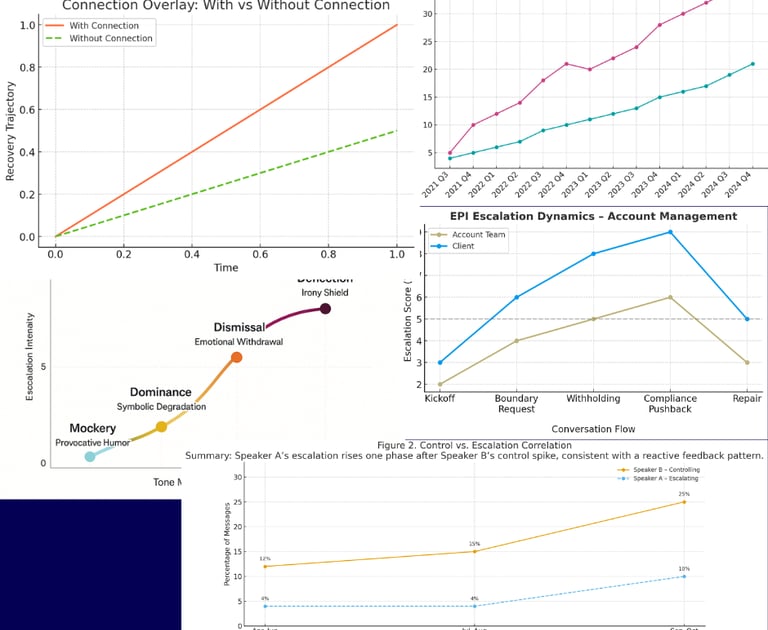
EPI was developed through iterative pattern analysis across real digital communication, rather than through hypothesis-first modeling or synthetic datasets.
The core methodology involved:
Longitudinal documentation of real communication across multiple contexts
Message-by-message tone tagging with attention to relational context
Tracking how responses unfolded over time (repair, escalation, withholding, boundary testing)
Refining pattern categories only when they recurred consistently across cases.
Discarding interpretations that did not persist under continued observation.
What persisted across this process were repeatable dynamics, not inferred traits or diagnoses.


Writing as Instrumentation
In EPI’s development, writing and structured reflection functioned as research instrumentation, not narrative output.
This process enabled:
real-time hypothesis formation
immediate falsification through continued observation
refinement of pattern categories based on recurrence rather than theory
detection of dynamics that did not surface through keyword or sentiment analysis
This approach aligns with established qualitative and systems-based research traditions, while extending them through systematic longitudinal tagging.
Writing was not the output of the process-
It was the instrument through which patterns became legible.
Constraint-Aware Framing
A defining methodological choice in EPI’s development was constraint-aware design.
Rather than maximizing detection, prediction, or automation, EPI was intentionally constrained to:
avoid diagnosing individuals
avoid inferring intent
avoid behavioral prediction
require human interpretation
prioritize early visibility over certainty
These constraints are methodological safeguards, not limitations.
They ensure that pattern visibility increases responsibility rather than replacing judgment.


Relational Dynamics Before Outcomes
EPI focuses on how interactions evolve over times, not on labeling people or outcomes.
Key dynamics surfaced through this methodology include:
escalation following vulnerability
boundary testing across time
failed or non-reciprocal repair
withholding as relational pressure
imbalance of emotional labor
These dynamics are often felt immediately in lived experience, but they rarely appear clearly in traditional documentation.
EPI’s methodology was built to surface these patterns before harm becomes obvious or irreversible.
Why This Approach Is Novel
EPI’s novelty does not come from proprietary scores or predictive claims.
It comes from the integration of:
longitudinal patterning
relational dynamics analysis
system-level modeling
constraint-aware ethical design
and governed human interpretation
Most tools optimize for speed or scale.
EPI optimizes for early clarity in high-stakes environments.


That tradeoff is intentional.


Cross-Domain Validation by Recurrence
Patterns identified through EPI’s development were not accepted based on a single domain.
They were evaluated for recurrence across contexts, including:
domestic and family systems
legal and custody-related communication
clinical and therapeutic settings
professional and workplace interactions
public and platform-based discourse
Patterns that did not recur were discarded.
Patterns that persisted across domains were refined.


This cross-context recurrence is a primary indicator of robustness.

Human-in-the-Loop Governance
EPI is designed as decision support, not authority.
Methodologically, this means:
outputs are structured for review, not conclusion
interpretation remains the responsibility of trained humans
ambiguity is preserved where certainty is not warranted
safeguards are built into deployment, not added later
This posture is especially critical in legal, clinical, and safety-related contexts.



Current Status and Ongoing Work
EPI remains an actively governed framework.
Ongoing methodological work includes:
supervised pilot programs
inter-rater consistency testing
refinement of pattern thresholds
validation design with research partners
continuous review of ethical safeguards
This reflects EPI’s core operating principle:
Clarity should precede scale.


How This Page Should Be Read
This methodology note is not a claim of completion.
It is a description of how EPI came into being, how its boundaries were set, and how its use is governed.
EPI continues to evolve through:
responsible application
structured feedback
and partnership with practitioners and researchers working in emotionally complex systems
If you are interested in:
supervised pilots
research collaboration
validation partnerships
or standards-building work... we welcome inquiry.


Connect
Explore
info@mindfulcommunications.io