Website expansion in progress...prototype coming soon.

Evidence & Case Studies
Most communication analysis focuses on individual messages.
EPI reveals what happens across time.
When emotional tone, response patterns, and relational dynamics are analyzed sequentially, structures become visible that are otherwise difficult to name or document.
These structures often determine whether communication stabilizes, deteriorates, or escalates.
Evidence emerges from patterns, not isolated moments.
ToneLogs: Making Emotional Dynamics Visible
ToneLogs are EPI’s foundational analytical output.
A ToneLog documents how communication unfolds message by message over time, capturing the emotional signals and relational dynamics that shape the interaction.
Each message is analyzed within its relational context, allowing patterns that are often felt immediately—but rarely documented clearly—to become visible.
ToneLogs are designed to support:
• clarity
• accountability
• professional interpretation
• responsible human judgment
—not diagnosis or blame.
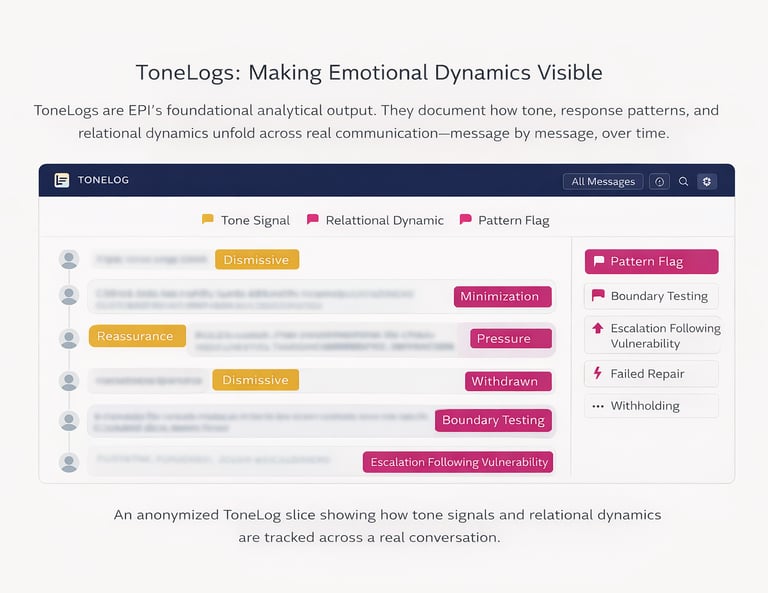
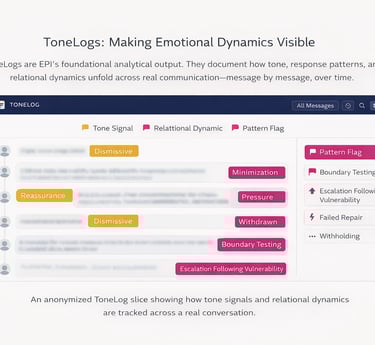
What matters is not a single message—but what repeats, shifts, or escalates across time.
Pattern Formation Over Time
While ToneLogs document structure at the message level, EPI’s pattern layer models direction.
This layer analyzes how relational dynamics repeat, intensify, stabilize, or fail to resolve across phases of interaction- revealing whether a communication system is moving toward repair, imbalance, or harm.
Rather than reacting to isolated moments, EPI surfaces:
accumulating relational pressure
failed or absent repair attempts
narrowing options for regulation and response
escalation following key relational events
These trajectories become visible long before crisis appears.
Pattern formation is where EPI moves from observation to foresight—making it possible to intervene responsibly, while meaningful options for repair still exist.
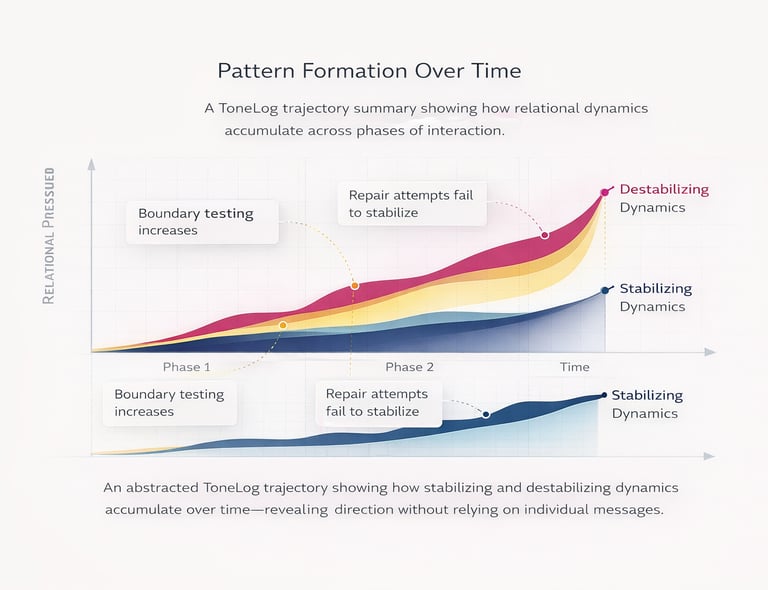
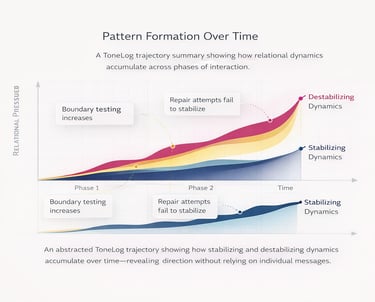
This layer shows where communication is heading—not just what was said.



What a Tonelog Reveals
ToneLogs surface structural dynamics within communication systems, including:
Escalation following vulnerability
Moments where emotional openness reliably triggers pressure, dismissal, or attack rather than support.Boundary testing over time
Repeated probing of stated limits that gradually increases relational strain.Failed or non-reciprocal repair
Apologies or repair attempts that do not stabilize the system because accountability or behavioral change does not follow.Withholding as relational pressure
Silence, delay, or disengagement used in ways that shape power and response.Imbalance of emotional labor
When one participant consistently carries regulation, repair, or accommodation while the other does not.
These patterns rarely appear through extreme language.
They emerge through timing, response and repetition.
EPI makes these dynamics visible early enough to support responsible human judgment...
before harm becomes entrenched.
Want to see what EPI would surface in your context?
When patterns are visible, meaningful intervention becomes possible.


Connect
Explore
info@mindfulcommunications.io